
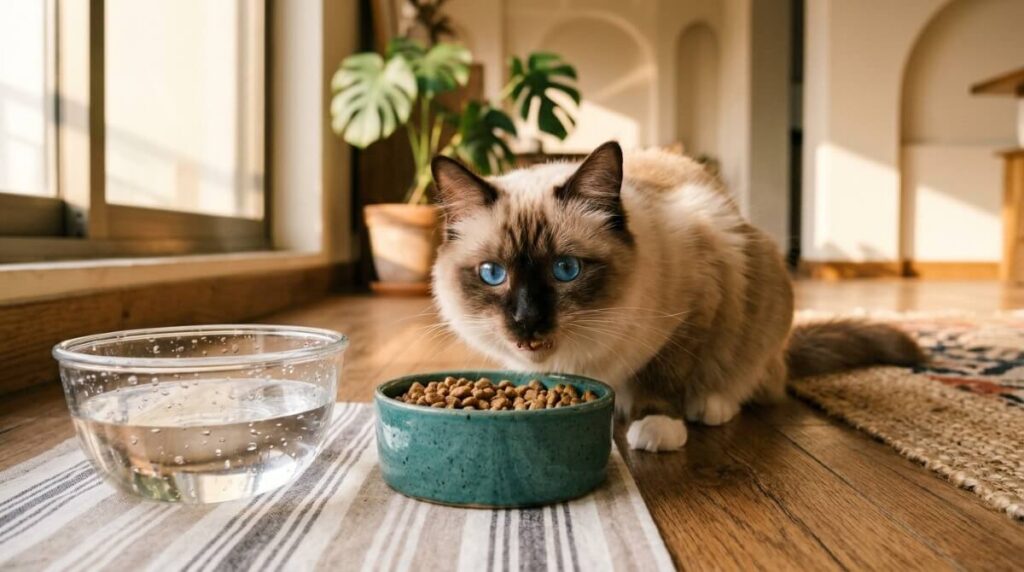
Walk into any pet shop in Lahore or Karachi and you will find shelves of cat food in every colour, flavour and price, from a few hundred rupees to several thousand. Most online “best cat food in Pakistan” lists simply rank brands. This guide does something more useful: it shows you how to judge any cat food yourself, how much to feed, and how to avoid the most common feeding mistakes, using guidance from veterinary organisations rather than marketing claims.
The short answer
- Choose a “complete and balanced” food made for your cat’s life stage (kitten, adult or all life stages).
- Look for named animal protein such as chicken or fish near the top of the ingredient list, and taurine in the formula.
- Feed measured meals, not an always-full bowl. Obesity is the most common nutrition problem in cats.
- Keep fresh water out at all times, especially in Pakistan’s summer, and add wet food if your cat drinks little.
- Switch foods slowly over 7 to 10 days to avoid stomach upsets.
Best Cat Food in Pakistan at a Glance
Want the shortlist first? Here are the six dry cat foods we stock, compared on the details that matter most. The rest of this guide explains how to judge these details for any cat food.
| Food | Life stage | Protein / fat | Taurine | First 3 ingredients | Packs and prices | Lowest price per kg | Best suited for | |
|---|---|---|---|---|---|---|---|---|
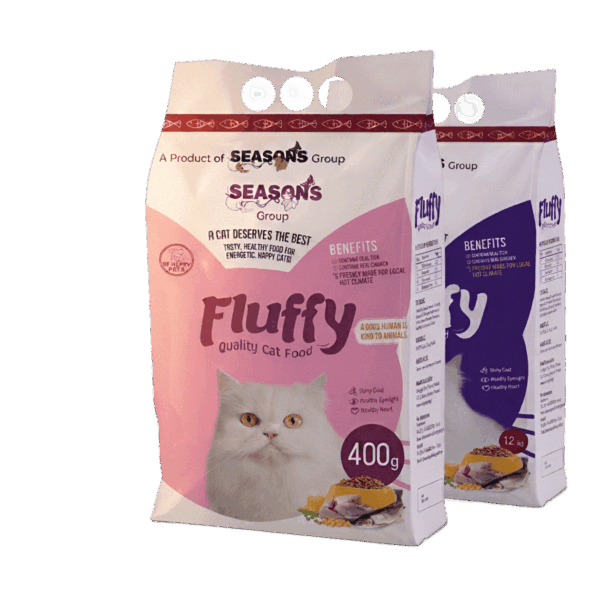 Fluffy Dry Cat Food | Adults; pack gives kitten (3 to 6 months) amounts | 30% / 9% (min) | Mentioned | Fish powder, chicken meal, chicken oil | 400 g Rs 269 1.2 kg Rs 769 | Rs 641 | Budget-conscious owners who want animal ingredients first | View |
 Pet Nosh Plus Meat & Veggie | All life stages (kittens and adults) | 26 to 30% / 5 to 9% | Added | Rice, poultry meal, fish meal | 1.2 kg Rs 1,200 | Rs 1,000 | Kittens, or homes with cats of different ages | View |
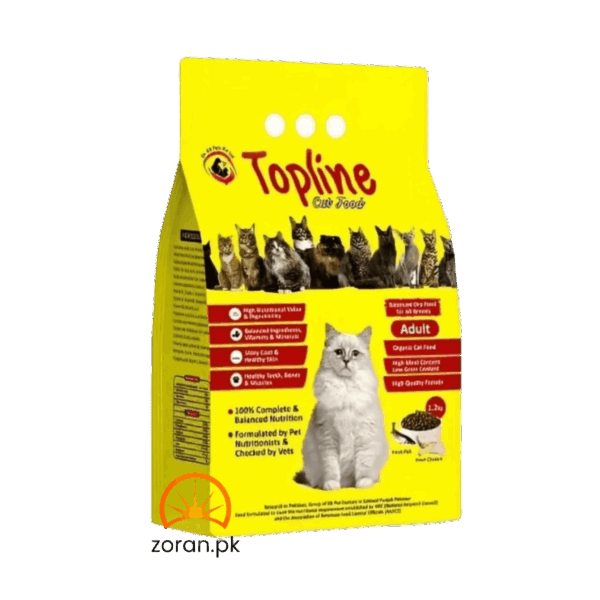 Topline Adult Dry Cat Food | Adult cats | 30% / 9% (min) | Mentioned | Soya bean meal, corn, poultry meat | 300 g Rs 329 1.2 kg Rs 859 | Rs 716 | Healthy adult cats on a budget | View |
 NourVet Naturals (Chicken & Brown Rice) | Cats and kittens | 32% (min) / 19% (max) | Added | Chicken, dehydrated chicken protein, brown rice | 500 g Rs 669 1 kg Rs 1,200 10 kg Rs 10,980 | Rs 1,098 | Kittens and adults; multi-cat homes buying in bulk | View |
 Feline Cat Food | All life stages (kittens and adults) | 30% / 12% (min) | Mentioned | Dehydrated chicken, protein, corn | 1.2 kg Rs 639 | Rs 533 | Owners who want the lowest price per kilo for kittens and adults | View |
 Whiskas Ocean Fish Kitten | Kittens, 2 to 12 months | 30% / 12% | Mentioned | Cereals (corn and/or rice), poultry by-product meal, palm stearin | 450 g Rs 1,250 1.1 kg Rs 2,500 3 kg Rs 7,250 | Rs 2,273 | Kittens, if you want a kitten-only formula with added DHA | View |
Lowest price per kilogram, by food
What Cats Actually Need
Cats are not small dogs, and they are certainly not small humans. The Cornell Feline Health Center describes cats as obligate carnivores: they must eat a balanced, meat-based diet because they need certain amino acids that are found in high levels in animal tissue.
The best-known example is taurine. Cats have a limited ability to make taurine themselves, so they need it from food. Without enough of it, cats can develop retinal degeneration that damages their eyesight and a serious heart condition called dilated cardiomyopathy, as veterinary extension specialists explain. Commercial cat foods include taurine at levels that meet or exceed a cat’s needs, which is one reason a properly made cat food is safer than a homemade bowl of chicken and rice.
How to Read a Cat Food Label in 60 Seconds
Bright packaging and words like “premium” or “natural” tell you very little. These five checks tell you much more.
SAMPLE CAT FOOD Chicken & Fish
2ADULT
1Sample Cat Food is formulated to meet the nutritional levels established for adult maintenance. Complete and balanced.
3Ingredients: Chicken meal, fish meal, rice, chicken fat, corn, beet pulp, vitamins, minerals, taurine.
5Best before: 06 / 2027 | Batch 2611A
- 1“Complete and balanced” statement, so it can be a cat’s whole diet.
- 2Life stage matches your cat: kitten, adult or all life stages.
- 3Ingredients are listed by weight. A named animal source near the top is a good sign.
- 4Guaranteed analysis and taurine let you compare foods fairly.
- 5Expiry date well in the future and an undamaged bag.
- 1Find the “complete and balanced” statement. According to AAFCO, a food labelled complete and balanced contains all required nutrients in the right ratios for a stated life stage: growth (kittens), adult maintenance, gestation and lactation, or all life stages. The US FDA notes that treats and supplements are usually not complete and should not be a cat’s main diet.
- 2Match the life stage to your cat. A kitten needs a growth or all-life-stages food. An adult-only food is not designed for a growing kitten.
- 3Check the first few ingredients. Ingredients are listed in order of weight, so a named animal source such as chicken, chicken meal, fish or fish meal near the top is a good sign. Treat it as one clue rather than a final verdict: some foods list a grain first but still meet complete and balanced standards, so read the ingredients together with the life-stage statement and the guaranteed analysis.
- 4Look for taurine in the ingredient or additive list, and read the guaranteed analysis for protein, fat, fibre and moisture.
- 5Check the expiry date and packaging. Cornell advises checking the expiry date, because large bags of dry food are often stored for months.
A quick trick for comparing protein
Dry and wet foods contain very different amounts of water, so their protein percentages are not directly comparable. Convert to a “dry matter” figure: divide the protein percentage by (100 minus the moisture percentage) and multiply by 100. For example, a dry food with 30% protein and 10% moisture has about 33% protein on a dry matter basis (30 divided by 90, times 100).
Judge the maker, not just the ingredient list
The World Small Animal Veterinary Association (WSAVA) recommends asking pet food companies whether they employ a qualified nutritionist, how they control quality, and what research supports their foods. Nutrition researchers at Tufts University make the same point: these factors say more about quality than an ingredient list. And as Clinician’s Brief notes, the makers that meet these standards are not necessarily the most expensive brands.
Dry vs Wet Cat Food: Which Is Better?
Both can be complete and balanced. The biggest difference is water. According to Cornell, canned food contains at least 75 percent moisture, making it a good source of water, while dry food is relatively inexpensive and convenient.
| Dry food (kibble) | Wet food (canned or pouch) | |
|---|---|---|
| Water content | Low, around 10% | High, 75% or more |
| Cost per meal | Lower | Higher |
| Storage | Easy, keep the bag sealed | Refrigerate after opening, do not leave out all day |
| Calories per gram | High, easy to overfeed | Lower, more filling per gram |
| Best for | Budget, convenience, busy homes | Cats that drink little, hot weather, picky eaters |
One practical option: many owners in Pakistan use a good dry food as the base and add some wet food, especially in summer or for cats that drink little. Others feed only dry or only wet food, and that can work well too if the food is complete and balanced and your cat drinks enough. Cornell also notes that feeding two or three different foods adds variety and may stop your cat becoming fixated on a single food, which helps if you ever need to change diets. If you want to try this, we stock Maybel Elite Wet Cat Food, a locally made chicken-flavour wet food (Rs 639 for 400 g). Its listing does not give a guaranteed analysis, so use it next to a complete dry food unless the pack says it is complete and balanced.
How Much Should You Feed Your Cat?
Feeding guides on packs are a starting point, but every cat is different. Vets estimate a cat’s daily calorie needs from its Resting Energy Requirement (RER), using the formula published by the American Association of Feline Practitioners: RER = 70 × (body weight in kg)0.75. For adult maintenance they multiply RER by about 1.2, and for growing kittens by 2.0 to 2.5.
Daily calorie calculator
This is an estimate for a healthy cat at a healthy weight. If your cat is overweight, underweight, pregnant or unwell, ask your vet for a feeding plan. For kittens, pregnant or nursing cats, breeds, wet food and other pets, use our full pet food calculator.
Two habits make the biggest difference. First, weigh or measure food with a kitchen scale or the same cup every time. Second, avoid leaving dry food out all day. Cornell veterinarians point to this “free feeding” as a major factor in feline obesity, which raises the risk of problems such as arthritis and diabetes.
How Much Does It Cost to Feed a Cat in Pakistan?
The price on the bag does not tell you the real cost. What matters is the price per kilogram and how much your cat eats each day. For example, the feeding chart on the Fluffy pack suggests about 75 g a day for a 4 kg cat. At Rs 641 per kg (the 1.2 kg pack), that is about Rs 1,450 a month, or roughly Rs 17,500 a year, for one cat.
To work out your own cat’s daily amount, monthly cost and how long a bag lasts, use the calculator below. It uses today’s prices for every cat food we stock.
Photo credits
- Alexandrine parakeet: Charles J. Sharp, CC BY-SA 4.0, via Wikimedia Commons (source)
- American Pit Bull Terrier: https://www.flickr.com/people/geoggirl/, CC BY 2.0, via Wikimedia Commons (source)
- Angora rabbit: Ross Little, CC BY-SA 2.0, via Wikimedia Commons (source)
- Aseel: Salmanrockx, CC BY-SA 4.0, via Wikimedia Commons (source)
- Australorp: JTdale, CC BY 3.0, via Wikimedia Commons (source)
- Beagle: , CC BY-SA 3.0, via Wikimedia Commons (source)
- Belgian Malinois: Canarian, CC BY-SA 3.0, via Wikimedia Commons (source)
- Bengal cat: User:Lightburst, CC BY-SA 4.0, via Wikimedia Commons (source)
- British Shorthair: BritishEmpire, CC BY-SA 3.0, via Wikimedia Commons (source)
- Budgerigar: Benjamint444, GFDL 1.2, via Wikimedia Commons (source)
- Bully Kutta: Nicolas2200, CC0, via Wikimedia Commons (source)
- Cockatiel: Photo by: Ganatron – paulweberphoto.com, CC BY-SA 4.0, via Wikimedia Commons (source)
- Commercial brown layer hens: Mercoaves, CC BY-SA 4.0, via Wikimedia Commons (source)
- Desi hen and rooster: Andrei Niemimäki from Turku, Finland, CC BY-SA 2.0, via Wikimedia Commons (source)
- Desi pigeon: william_stephens, CC BY 4.0, via Wikimedia Commons (source)
- Dobermann: Miroslav Cacik, Copyrighted free use, via Wikimedia Commons (source)
- Dwarf hamster: Bullet, CC BY-SA 3.0, via Wikimedia Commons (source)
- English Cocker Spaniel: Jean-Pol GRANDMONT, CC BY 4.0, via Wikimedia Commons (source)
- Fayoumi: Joe Mabel (on Flickr as Joe Mabel from Seattle, US), CC BY-SA 3.0, via Wikimedia Commons (source)
- Flemish Giant rabbit: Lucile Petit, Public domain, via Wikimedia Commons (source)
- Gaddi Kutta: Shyamal L., CC BY-SA 3.0, via Wikimedia Commons (source)
- German Shepherd: gomagoti, CC BY-SA 2.5, via Wikimedia Commons (source)
- Golden Retriever: Dukedestiny01.jpg: "Janneke Vreugdenhil" derivative work: Anka Friedrich ([[User, Public domain, via Wikimedia Commons (source)
- Goldfish: לינה אבוגוש, CC BY-SA 3.0, via Wikimedia Commons (source)
- Grey parrot: Florettesokeng, CC BY-SA 4.0, via Wikimedia Commons (source)
- Guinea pig: , CC BY-SA 3.0, via Wikimedia Commons (source)
- Guppy tropical fish: Per Harald Olsen, CC BY 3.0, via Wikimedia Commons (source)
- High flyer tippler pigeon: jim gifford, CC BY-SA 2.0, via Wikimedia Commons (source)
- Himalayan cat: Cindy See, CC BY-SA 2.0, via Wikimedia Commons (source)
- King pigeons: Graham Manning, CC BY-SA 3.0, via Wikimedia Commons (source)
- Labrador Retriever: IDS.photos from Tiverton, UK, CC BY-SA 2.0, via Wikimedia Commons (source)
- Lakha fantail pigeon: jim gifford, CC BY-SA 2.0, via Wikimedia Commons (source)
- Maine Coon: , CC BY-SA 4.0, via Wikimedia Commons (source)
- Mini Lop: MiniLop1234, CC BY-SA 4.0, via Wikimedia Commons (source)
- Mixed breed rabbit: Friedrich Haag, CC BY-SA 4.0, via Wikimedia Commons (source)
- Mixed or desi dog: Biswarup Ganguly, CC BY-SA 3.0, via Wikimedia Commons (source)
- Mixed or desi tabby cat: Bertramz, CC BY-SA 3.0 de, via Wikimedia Commons (source)
- Netherland Dwarf rabbit: 金色黎明, CC BY-SA 4.0, via Wikimedia Commons (source)
- New Zealand rabbit: No machine-readable author provided. Hagen Graebner assumed (based on copyright , CC BY-SA 2.5, via Wikimedia Commons (source)
- Persian cat: The original uploader was Lajoma at Finnish Wikipedia., CC BY-SA 3.0, via Wikimedia Commons (source)
- Pomeranian dog: Blackoranges, Public domain, via Wikimedia Commons (source)
- Racing homer pigeon: Patrick Edwin Moran, Public domain, via Wikimedia Commons (source)
- Ragdoll: Simone Johnsson, CC BY-SA 2.0, via Wikimedia Commons (source)
- Rhode Island Red: HeatherLion, CC BY-SA 3.0, via Wikimedia Commons (source)
- Rose-ringed parakeet: danielskatz, CC BY 4.0, via Wikimedia Commons (source)
- Rosy-faced lovebird: Charles J. Sharp, CC BY-SA 4.0, via Wikimedia Commons (source)
- Rottweiler: Dr. Manfred Herrmann Allgemeiner Deutscher Rottweiler-Klub (ADRK) e.V. http://ww, CC BY-SA 3.0, via Wikimedia Commons (source)
- Shih Tzu: Canino21, Public domain, via Wikimedia Commons (source)
- Siamese cat: Whitepatrick, CC BY-SA 4.0, via Wikimedia Commons (source)
- Siberian Husky: xJaM (talk · contribs), CC BY-SA 3.0, via Wikimedia Commons (source)
- Silkie bantam hen: Camille Gillet, CC BY-SA 4.0, via Wikimedia Commons (source)
- Syrian hamster: Adamjennison111 at English Wikipedia, CC BY 2.5, via Wikimedia Commons (source)
- Zebra finch: see source, CC BY 2.5, via Wikimedia Commons (source)
Three ways to spend less without cutting quality: buy the larger pack of a food your cat already likes, measure portions so nothing is wasted or overfed, and store opened food properly so none goes stale.
Feeding Kittens, Adults and Senior Cats
Kitten up to about 12 months
- Food
- Growth or all life stages
- Meals a day
- 3, then 2 after about 3 months
- Energy needs
- 2 to 2.5 × resting needs
- Example
- 2 kg kitten: about 235 to 295 kcal a day
Adult 1 year and over
- Food
- Adult maintenance or all life stages
- Meals a day
- 2 measured meals
- Energy needs
- About 1.2 × resting needs
- Example
- 4 kg adult: about 240 kcal a day
Kittens
Up to about 12 months
- Feed a growth or all-life-stages food.
- Small, frequent meals: vets often suggest three meals a day up to about 12 to 14 weeks, then two (Greencross Vets).
- Kittens need roughly two to two and a half times the calories of their resting needs.
Adults
1 to about 10 years
- Feed an adult maintenance or all-life-stages food.
- Two measured meals a day suits most homes.
- Neutered and indoor cats often need less food than the pack suggests.
Seniors
Older cats
- Watch for changes in appetite, weight or thirst and see your vet if you notice them.
- Cats with dental problems may find wet food easier to eat.
- Do not change diets suddenly.
One warning applies at every age: Cornell notes that a cat that refuses to eat can develop serious medical problems. If your cat stops eating, contact your vet promptly rather than waiting it out.
Feeding Cats in Pakistan’s Climate
Long, hot summers and a humid monsoon make a few habits especially important here.
- Keep water everywhere. Put out more than one bowl of fresh water, refill it daily and keep it out of direct sun. Cats Protection notes that cats eating dry food may need to drink more than cats on wet food.
- Add wet food in summer if your cat drinks little, since wet food supplies much of its own water.
- Store dry food properly. Once opened, dry food can dry out or go rancid, according to Cornell. Keep it in its original bag, closed tightly, inside an airtight container away from heat and damp.
- Check for damp or mould during the monsoon, and throw away any food that smells off or looks clumped.
- Never leave wet food out for hours in the heat. Remove what your cat does not eat.
Foods You Should Never Give Your Cat
The ASPCA Animal Poison Control Center lists common human foods that are dangerous for pets. These are the ones most likely to be found in a Pakistani kitchen:
If you think your cat has eaten something harmful, contact your vet immediately.
How to Switch Cat Food Without Upsetting Your Cat
A sudden change can cause vomiting, diarrhoea or food refusal. The American Association of Feline Practitioners recommends changing gradually over 7 to 10 days, and sometimes longer for cautious cats. A schedule like this one from PetMD works for most cats:
If your cat leaves food or has soft stools, go back a step and slow down. Never try to force a cat onto a new food by withholding its old one.
Which Cat Food Is Best for Your Cat?
There is no single best cat food for every cat. The right choice depends on your cat’s age, health and appetite, and on your budget. Based on the label details above, here is how the foods we stock fit different needs.
Best for kittens
Why: It is labelled for all life stages, so it suits growing kittens and homes with cats of different ages. Taurine, vitamins and minerals are added.
Keep in mind: Rice is listed first, and its protein (26 to 30%) is a little lower than the other foods here.
Rs 1,200 for 1.2 kgView product
Best budget pick
Why: One of the lowest prices per kilo here, with fish powder and chicken meal as the first ingredients and a fully published analysis (30% protein, 9% fat). Locally made.
Keep in mind: The pack gives kitten feeding amounts from 3 months, but for very young kittens a food labelled for growth or all life stages is the safer choice.
From Rs 269View product
Best for adult cats on a budget
Why: An adult-specific formula with 30% protein, 9% fat and taurine, at a low price per kilo in the 1.2 kg size.
Keep in mind: Soya bean meal and corn are listed before poultry. It is designed for adult cats only, not kittens.
From Rs 329View product
Highest protein and multi-cat homes
NourVet Naturals Chicken & Brown Rice
Why: Chicken and dehydrated chicken protein are the first two ingredients, it has the highest protein of the foods here (32% minimum), and it is labelled for both cats and kittens. The 10 kg pack also means fewer reorders when you feed several cats.
Keep in mind: It costs more per kilo than every dry food here except the Whiskas kitten food. Buy the 500 g size first to see if your cats like it.
From Rs 669View product
Lowest price per kilo
Why: At Rs 533 per kg it is the cheapest food here, and it is labelled for all life stages and formulated to AAFCO guidelines. Dehydrated chicken is listed first, with 30% protein and 12% fat, plus taurine.
Keep in mind: Corn, flour and brewer’s rice come high in the ingredient list, and it comes in one pack size only.
Rs 639 for 1.2 kgView product
Kitten-only formula
Why: Made for kittens aged 2 to 12 months, with 30% protein, 12% fat, taurine and DHA for brain and eye development. Three pack sizes, up to 3 kg.
Keep in mind: Cereals and poultry by-product meal are listed first, and it costs the most per kilo here (from Rs 2,273 per kg in the 1.1 kg pack). Switch to an adult food at about 12 months.
From Rs 1,250View product

Wet food to add moisture
Why: A locally made, chicken-flavour wet food. Adding some to a dry diet raises your cat’s water intake, which helps in summer and for cats that drink little.
Keep in mind: Its listing gives no guaranteed analysis or “complete and balanced” statement, so use it alongside a complete dry food unless the pack says it is complete.
Rs 639 for 400 gView product
Whichever you choose, introduce it gradually over 7 to 10 days. You can browse all of our cat food and cat products here, with Cash on Delivery across Pakistan.
Before you buy: a quick checklist
- Says “complete and balanced” for my cat’s life stage
- Ingredient list and guaranteed analysis checked
- Taurine included
- Expiry date well in the future, bag undamaged
- Pack size I can use up while it is still fresh
- A plan to switch over 7 to 10 days
Cat Feeding Guides to Save and Share
Want a quick reference? Save these graphics to your phone or share them with other cat owners. Tap any image to open it at full size.


Frequently Asked Questions About Cat Food
How much dry food should I feed my cat per day?
It depends on your cat’s weight, age and activity, and on how many calories the food contains. A healthy 4 kg adult cat needs roughly 240 kcal a day. For a typical dry food with 3,500 to 4,000 kcal per kg, that is about 60 to 70 grams. Use the calculator above or the pack’s feeding chart as a starting point, then adjust if your cat gains or loses weight.
Can I give my cat milk?
It is best not to. Most adult cats cannot digest lactose properly, so milk can cause diarrhoea and stomach upset. Fresh water is all an adult cat needs to drink.
Can cats eat rice, roti or boiled chicken?
Small amounts of plain boiled chicken are fine as an occasional treat, but rice, roti and chicken do not make a complete diet. Cats need nutrients such as taurine in the right amounts, which a complete and balanced cat food provides. Never feed food cooked with onion or garlic.
Is wet food better than dry food for cats?
Neither is automatically better. Wet food provides much more water and is useful for cats that drink little or live in hot weather. Dry food costs less and is easier to store. Many owners feed a mix of both.
Can kittens eat adult cat food?
Kittens should eat a food labelled for growth or for all life stages, because they need more calories and nutrients while growing. An adult maintenance food is not designed to support that growth.
How often should I feed my cat?
Young kittens do best with small, frequent meals. Most adult cats do well on two measured meals a day. Avoid leaving a full bowl of dry food out all day, which is linked to weight gain.
How long does an opened bag of dry cat food last?
Use it before the expiry date and keep it tightly sealed, because opened dry food can dry out or go rancid. Buying a pack size your cat will finish within a few weeks helps keep it fresh, especially in humid weather.
Is local cat food as good as imported cat food?
Price and origin alone do not decide quality. Check that the food is complete and balanced for your cat’s life stage, has named animal protein and taurine, and comes from a maker that can answer basic questions about nutrition and quality control.
Which cat food is best for kittens in Pakistan?
Choose a food labelled for growth or for all life stages. Of the foods we stock, Pet Nosh Plus and Feline are labelled for all life stages, including kittens, and Whiskas Ocean Fish Kitten is made only for kittens aged 2 to 12 months. Whatever brand you choose, check the life-stage statement on the pack and feed small, frequent meals.
How much does it cost to feed a cat per month in Pakistan?
It depends on the food and your cat’s size. As an example, a 4 kg cat eating about 75 g a day of a dry food costing Rs 708 per kg costs roughly Rs 1,600 a month. Use the monthly cost calculator in this guide to work out your own figure.
Where can I buy cat food online in Pakistan?
Zoran.pk delivers cat food across Pakistan with Cash on Delivery, usually within 2 to 5 working days. You can compare the foods we stock in the table at the top of this guide.
Sources
- Cornell Feline Health Center, Cornell University. Feeding Your Cat. Read the source
- Cornell University College of Veterinary Medicine. Feline obesity. Read the source
- Companion Animals Extension. Taurine Requirement of Cats. Read the source
- Association of American Feed Control Officials (AAFCO). How to Understand a Dog or Cat Food Label. Read the source
- US Food and Drug Administration. “Complete and Balanced” Pet Food. Read the source
- WSAVA Global Nutrition Committee. Guidelines on Selecting Pet Foods. Read the source
- Petfoodology, Tufts University. Asking the Right Questions to Make Informed Decisions about Pet Foods. Read the source
- Clinician’s Brief. Advising Pet Owners on Nutritional Adequacy. Read the source
- American Association of Feline Practitioners. Resting energy requirement calculation (The Feline Practitioner, 2022). Read the source
- American Association of Feline Practitioners, Cat Friendly Homes. Changing Your Cat’s Food. Read the source
- PetMD. How To Switch Cat Food. Read the source
- ASPCA Animal Poison Control Center. People Foods to Avoid Feeding Your Pets. Read the source
- Cats Protection. Cats and drinking. Read the source
- Greencross Vets. A guide to feeding your kitten. Read the source
This guide is for general information and is not veterinary advice. If your cat has a health condition, is pregnant, or is losing or gaining weight, ask your vet for a feeding plan.